
Planning custom coffee bar equipment? This guide covers coffee bar layout design, commercial equipment list, bar dimensions, countertop materials, plumbing and electrical requirements, and budget tips for new coffee shops and bar renovations.
When planning custom coffee bar equipment, the goal is not simply fitting machines into a cabinet. It is designing the bar around your menu, peak-hour volume, and number of baristas—then positioning equipment, counter zones, and utility connections accordingly. Plan first, buy later. This avoids common problems such as machines that do not fit, insufficient power, or cabinet doors that cannot open.
1. Four Questions to Answer Before Customizing a Coffee Bar
-
What is on the menu? Espresso only, or coffee plus tea, iced drinks, and light food? This determines whether you need an ice maker, tea brewer, blender, or other equipment.
-
What is your peak-hour output? Average daily sales do not reveal bottlenecks. The key is how many drinks you can serve during your busiest hour. Under 150 cups per day, a single-group or entry-level double-group semi-automatic machine is often enough. For 150–300 cups, a double-group semi-automatic is common. For higher-volume grab-and-go service, consider a fully automatic machine or multiple grinders.
-
How many baristas work at the same time? One person handling the full workflow requires a different bar length and equipment spacing than two people working at separate stations.
-
How do customers move? Ordering, waiting, and pickup paths should not pass through the barista work area.
2. Coffee Bar Layout Design: The Key to Efficiency
The goal of coffee bar layout design is to let the barista pick up a cup, grind, extract, steam milk, and serve without taking extra steps. The espresso machine, grinder, milk refrigeration, and steaming station should be within arm’s reach. Place the grinder on the barista’s dominant-hand side and the milk fridge close to the steam wand. Dirty cup return and clean cup storage should follow two separate paths to avoid cross-traffic during peak hours.
Before customizing, request original dimension drawings from equipment suppliers and place them into the bar plan to scale. Reserve three types of space: operating space (portafilter movement, tamping), access space (hopper lid opening, fridge door opening, trash removal), and service space (panel removal, filter replacement).
3. Commercial Coffee Bar Equipment List & Selection
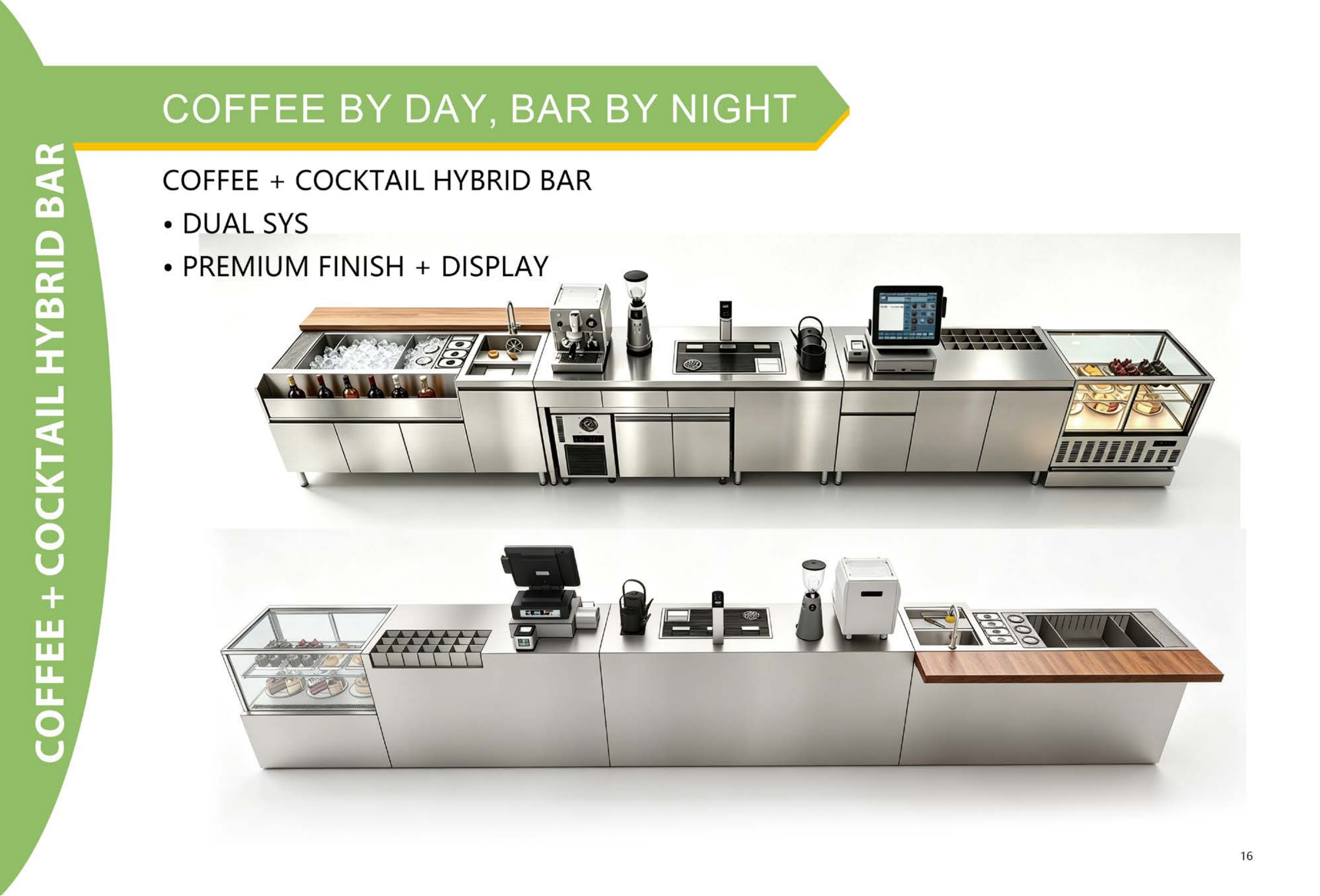
A typical commercial coffee bar equipment list includes:
-
Espresso machine: Choose semi-automatic or fully automatic based on peak output. Confirm dedicated circuit and ventilation space.
-
Grinder: Commercial electronic dosing grinder; burr size should match your output rhythm.
-
Ice maker: Essential for iced drinks. Confirm daily ice capacity, storage bin, heat dissipation, and independent drainage.
-
Water filtration system: Configure separately or zone water supply for espresso machine and ice maker to protect heating elements and ensure clean ice.
-
Refrigerated worktable: Keep milk within reach of the steaming station. Confirm door swing direction and compressor ventilation clearance.
-
Sink and washing area: The sink should be wide enough to wash milk pitchers and latte cups at an angle. Place it near the operator side and align it with the dirty cup return path.
-
Syrup rack, knock box, and trash bin: Use built-in or under-counter storage to reduce countertop clutter.
4. Coffee Bar Dimensions & Countertop Materials
There is no universal coffee bar dimension standard, but the worktop depth must accommodate the espresso machine, grinder, and operator hand space. Leave enough clearance for portafilter movement and tamping. In small shops, prioritize the core work triangle rather than a long counter.
For coffee bar countertop materials, use zone-based selection: 304 stainless steel for the operating zone for stain resistance and easy cleaning; sintered stone or quartz for display areas to improve appearance. Sintered stone is hard but brittle and can chip when cups or pitchers hit it, so it is not ideal for high-frequency work zones. Finish seams properly to prevent water penetration.
5. Coffee Bar Plumbing & Electrical Requirements: The Least Reversible Step
Once cabinet panels are sealed, utility points are very difficult and costly to change. Before customization, confirm:
-
Electrical: Espresso machines usually require a dedicated circuit. Ice makers, grinders, refrigerators, and water heaters should be on separate circuits. Check remaining capacity in the distribution panel.
-
Plumbing and drainage: Espresso machines, ice makers, and sinks have different inlet flow and drainage requirements. Ice makers need independent drainage with adequate slope. Reserve pipe routes inside the cabinet in advance.
-
Ventilation and service access: Built-in espresso machines, ice maker compressors, and water filters all need heat dissipation and replacement space. Do not reserve installation dimensions only—reserve service dimensions.
6. How to Structure a Coffee Bar Budget
Divide the coffee bar budget into three lines: equipment, cabinet and countertop, and utility renovation. Select equipment based on peak output. Allocate cabinet and countertop spending by operating zone versus display zone. Complete utility work properly in one go—retrofitting later costs much more. Treat a custom bar as infrastructure for workflow efficiency and productivity, not just decoration.
FAQ: Custom Coffee Bar Equipment
Q1: How much does custom coffee bar equipment cost?
A: It depends on equipment grade, bar length, countertop material, and utility renovation scope. First define your menu and peak volume, then ask suppliers to quote based on the equipment list and utility plan.
Q2: How do I determine coffee bar dimensions?
A: Work backward from original equipment dimensions, operator hand space, door opening, and service clearance. Prioritize the work triangle of espresso machine, grinder, and milk refrigeration.
Q3: What countertop material is best for a coffee bar?
A: Use 304 stainless steel for the operating zone and sintered stone or quartz for display areas. Zone-based selection is more practical than one material for the entire bar.
Q4: What is most often missed in a custom coffee bar?
A: Dedicated circuits, ice maker drainage slope, water filtration points, equipment ventilation, and service access. These must be confirmed before cabinet production.